- 16.03.2026 - 08:00
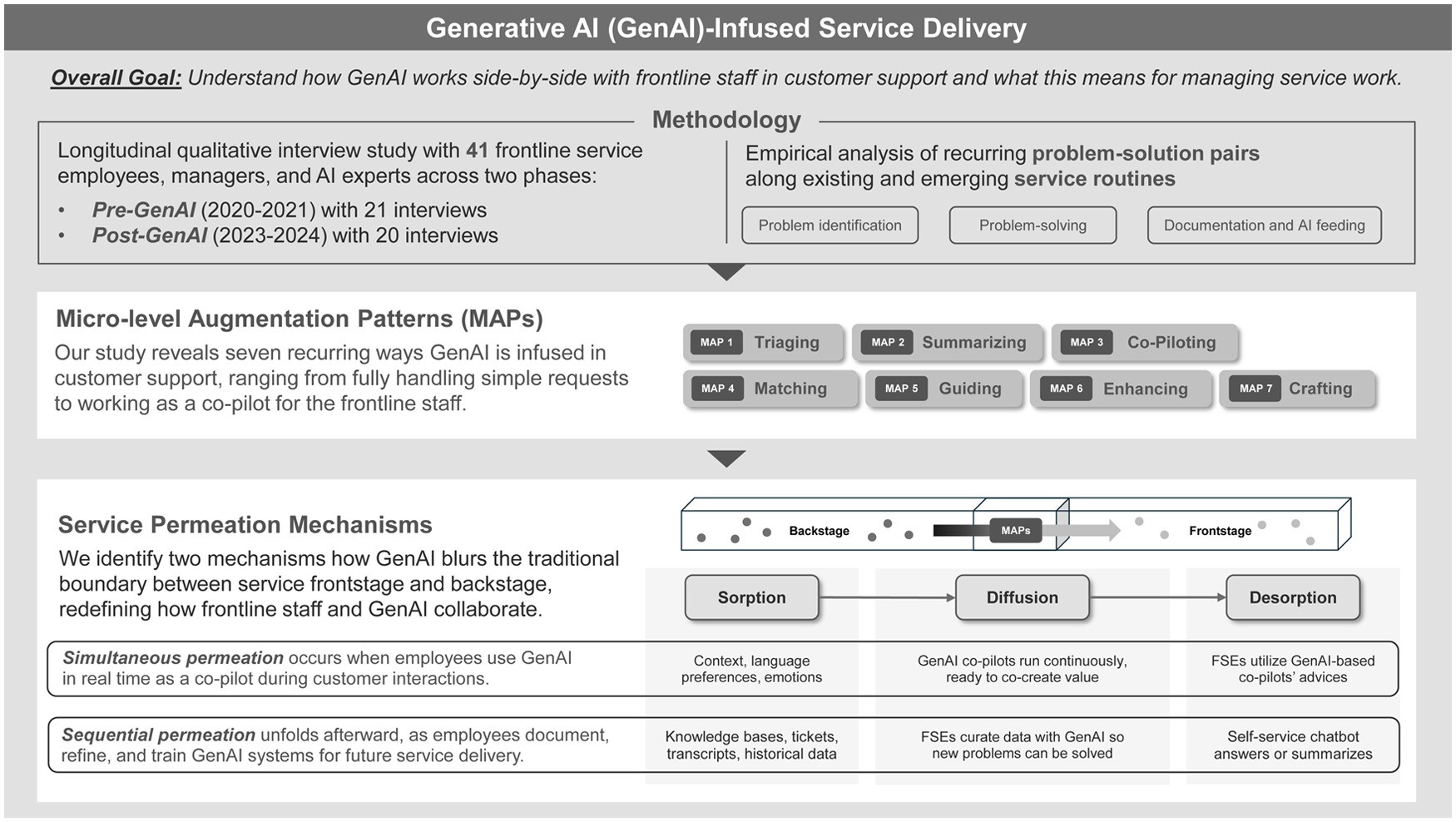
Based on a longitudinal study (2020–2024) comprising 41 interviews, the authors identify seven recurring patterns that describe how GenAI is integrated into service processes. The findings show that GenAI is initially deployed within the internal operations of knowledge-intensive services and, from there, increasingly shapes customer interactions. The authors identify two mechanisms of service penetration: (1) simultaneous penetration, in which staff use GenAI in real time during customer interactions, and (2) sequential penetration, in which documentation routines continuously improve service processes. The study provides important insights into human-AI collaboration in a service context and demonstrates how organisations can effectively integrate generative AI into service processes.
Abstract: The infusion of generative AI (GenAI) is already disrupting established services. This technology’s generative and agentic nature challenges the design and management of service routines, which have been previously handled primarily by frontline service employees. Guided by organizational routines theory, our longitudinal study (2020–2024) examines how the infusion of GenAI changes routines in customer support services. We gathered interview data from 41 employees, managers, and AI experts in two phases, pre- and post-GenAI. Based on the analysis of the qualitative data, we revealed seven recurring micro-level augmentation patterns, illustrating how GenAI-infused service routines function. The results show that GenAI is primarily embedded in the backstage of knowledge-intensive services, from which it then permeates the frontstage. We contribute to the literature on hybrid human–AI service delivery by identifying augmentation patterns and conceptualizing service permeation via two mechanisms: (1) simultaneous service permeation, which unfolds as employees leverage GenAI in real-time and integrate GenAI’s responses, recommendations, and adaptations into the frontstage; (2) sequential service permeation, which emerges as employees perform new routines of documentation and AI feeding to facilitate GenAI’s adaptability in frontstage and backstage operations. The MAPs and service permeation mechanisms guide practitioners in integrating GenAI into service routines and managing novel employee-GenAI collaborations.